How Many Calories Should I Eat To Lose Weight
Tired of confusing advice on how many calories should I eat? Get a simple, no-nonsense guide to find your personal number for weight loss or muscle gain.
Love This Article?
Get personalized meal plans with recipes like this, automatically matched to your nutrition targets.
So, you’re asking, "How many calories should I eat?" The quick and dirty answer you hear everywhere is that the average woman should aim for around 1,500 calories for weight loss and 2,000 to maintain. For men, the numbers usually tossed around are 2,000 for loss and 2,500 for maintenance.
But let's be real: these are just ballpark figures. Think of them as a launchpad, not the final destination. Your actual target is deeply personal and depends on everything from your age to how much you chase after your kids.
Ditching Generic Advice for Your Real Calorie Number
Those one-size-fits-all calorie counts are plastered all over the internet, but they fail to see you. They don’t know if you’re a busy stay-at-home mom who’s constantly on her feet or if your biggest workout of the day is walking to the coffee machine. Your body's energy needs are as unique as your fingerprint.
Figuring out your personal daily calorie goal is the single most important step you can take, whether you're trying to lose weight, build muscle, or just maintain where you are with more energy. It’s how you stop the endless guessing and finally break through those frustrating plateaus.
Why Personalization Is King
Relying on generic numbers is a recipe for failure. They ignore the very things that make you different, leading to some common (and annoying) problems. A personalized approach helps you sidestep these issues and get results that actually stick.
- Consistent Energy: Eating the right amount for your body means you can say goodbye to those afternoon energy slumps and feel genuinely good all day.
- Smarter Goal Setting: Once you have a real target, planning meals that actually help you get there becomes a hundred times easier.
- No More Frustration: A calorie goal that’s way too low can backfire and tank your metabolism. One that’s too high will just leave you wondering why nothing is changing.
Where Do These Numbers Even Come From?
Those general recommendations aren't just pulled out of thin air. They’re based on broad population averages. For example, the UK’s National Health Service (NHS) suggests an average man needs about 2,500 kilocalories daily to maintain his weight, while an average woman needs around 2,000 kilocalories.
These are solid benchmarks, but remember the keyword: average. They assume typical activity levels and body sizes that might be nothing like yours.
Key Takeaway: The point isn't to find a single "perfect" number that you have to stick to forever. The real goal is to find a smart starting point that you can tweak and adjust as your body and your life change.
Ready to find your number? This guide will walk you through exactly how to calculate your unique calorie needs. We're about to leave the generic advice in the dust.
Quick Daily Calorie Estimates By Goal
For a quick reference, the table below offers a general starting point based on broad averages for adult men and women. Think of this as a "quick start" guide before you dive into a more personalized calculation.
| Gender | Weight Maintenance | Weight Loss (approx. 1 lb/week) | Weight Gain (approx. 1 lb/week) |
| Women | 2,000 calories | 1,500 calories | 2,500 calories |
| Men | 2,500 calories | 2,000 calories | 3,000 calories |
Remember, these are just estimates! Factors like age, height, muscle mass, and daily activity will significantly influence your true needs. Now, let's get to the good part: calculating the number that's right for you.
Finding Your Body's "Idle Speed"
Ever wonder how much fuel your body burns just by being alive? Think of it like a car idling at a stoplight. The engine is still running, consuming gas just to keep things ticking over. That's your Basal Metabolic Rate (BMR)—the baseline number of calories your body needs to handle all its behind-the-scenes jobs.
We're talking about the energy required for breathing, keeping your heart beating, and even thinking. This is the bare minimum, the cost of admission for being you, even if you spent the entire day crashed on the couch with a Netflix marathon. Getting this number right is the crucial first step, moving you away from random online calculators and toward a calorie target that actually fits your body.
Time for a Little Math (The Easy Kind)
You don't need a fancy lab coat or a team of scientists to figure this out. We can get an impressively accurate estimate with a formula called the Mifflin-St Jeor equation. It's considered the most reliable method out there, and don't worry, it only looks intimidating.
Let's walk through it with a real-world example. Meet Alex, a 30-year-old marketing manager who is 5'6" (168 cm) and weighs 150 lbs (68 kg). We'll pop her numbers into the formula to see how it works.
- Men: (10 x weight in kg) + (6.25 x height in cm) – (5 x age in years) + 5
- Women: (10 x weight in kg) + (6.25 x height in cm) – (5 x age in years) – 161
Here’s Alex's calculation:
(10 x 68 kg) + (6.25 x 168 cm) – (5 x 30 years) – 161
Let’s break that down:
680 + 1050 – 150 – 161 = 1,419 calories
Boom. Alex's BMR is roughly 1,419 calories. That's the energy her body burns every day just to stay operational, before she even takes a single step.
Why is this so important? Because your BMR makes up the lion's share of your daily calorie burn—usually somewhere between 60% and 75% of the grand total. If you get this number wrong, everything else will be off.
Your Turn: Find Your Baseline
Okay, grab your phone's calculator. It’s time to find your own number. Just follow the formula, and don't get hung up on getting it perfect down to the last digit. We're looking for a solid starting point, not launching a rocket.
Here's your quick checklist:
- Get your weight in kilograms: Pounds / 2.205 = kg
- Get your height in centimeters: Inches x 2.54 = cm
- Plug and play: Put your age, weight (kg), and height (cm) into the correct formula for your gender.
Got it? That number you're looking at is your personal "idle speed." It's the foundation we'll use to build out your complete daily calorie needs in the next step.
Time to Factor in Real Life: Your Activity Level
Think of your BMR as what your body burns just by existing—like a car idling in the driveway. But you're not idling all day, are you? You’re chasing kids, walking the dog, hitting the gym, or even just fidgeting at your desk. All that movement burns calories.
To get a true picture of your daily calorie needs, we need to upgrade your BMR to your Total Daily Energy Expenditure (TDEE). This is the magic number that accounts for everything you do from sunup to sundown.
The process is surprisingly simple: we just multiply your BMR by a number that reflects your typical activity level.
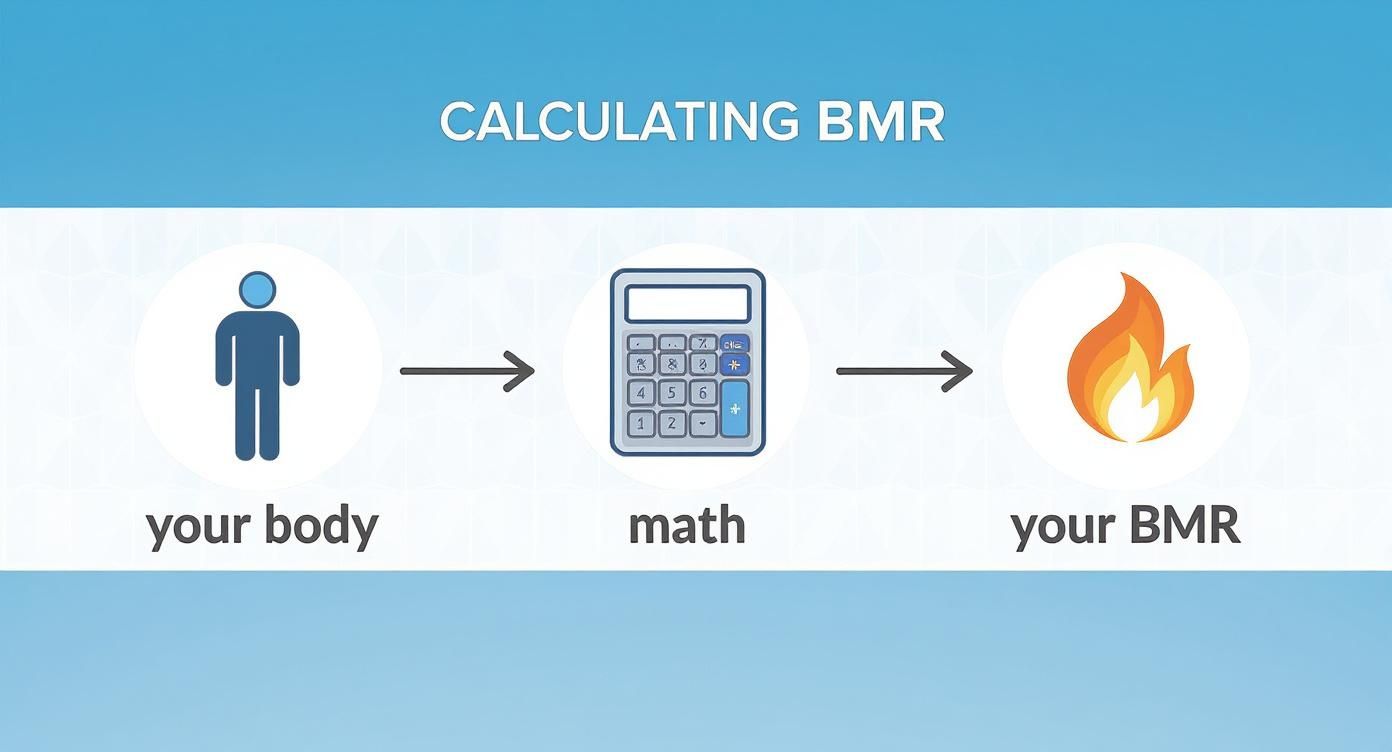
This turns a few body stats into a solid foundation—your BMR—which we'll now build upon to figure out your true daily burn.
Find Your Activity Multiplier
Choosing the right activity multiplier is where a little honesty goes a long way. This is probably the single biggest mistake people make. They think about their best, most active week instead of their typical week. Be real with yourself for the best results.
To find your number, just look at the table below and see which description fits you best.
| Activity Level | Description | Multiplier |
| Sedentary | You have a desk job and get little to no intentional exercise. | 1.2 |
| Lightly Active | You’re mostly sedentary but get in a walk or light workout 1-3 days a week. | 1.375 |
| Moderately Active | You exercise with intention 3-5 days a week. This is a common sweet spot. | 1.55 |
| Very Active | You're hitting the gym hard 6-7 days a week or have a physically active job. | 1.725 |
| Extra Active | You’re an athlete in training or work a demanding job *and* work out. | 1.9 |
Just find yourself on the chart, grab the multiplier, and you're ready for the next step.
Let's check back in with our example, Alex. Her BMR was 1,419 calories. She works a marketing job, which is pretty sedentary, but she loves her spin class and makes it happen three times a week. That puts her squarely in the "Moderately Active" camp.
Here's Alex's TDEE Calculation:
1,419 (BMR) x 1.55 (Activity Multiplier) = 2,199 calories per day
Boom. That number, 2,199, is Alex's maintenance level. It's the amount of calories she needs to eat every day to stay exactly the same weight, factoring in both her resting metabolism and her real-world activity.
If your days are particularly demanding, making sure your meals pack enough punch is critical. You can get some inspiration from these 10 meal prep recipes for high-energy activity days to keep your engine running strong.
It's also pretty eye-opening to see how our personal needs compare to the rest of the world. The UN reported that the global average daily intake hit 2,960 kilocalories in 2021, while North America averaged a whopping 3,540 kilocalories. It just goes to show you that a "one-size-fits-all" number is pretty useless when it comes to your own health.
Time to Fine-Tune: Setting Calories for Your Real-World Goal
Okay, you've crunched the numbers and found your TDEE. Think of that number as your body's "neutral" setting—it's what you need to stay exactly as you are. But we’re not here to stay the same, right?
Now comes the fun part: putting that number to work. We're going to shift gears and point you directly toward your goal, whether that's shedding fat or building muscle. And don't worry, this isn't about miserable diets or drastic overhauls. It's about a small, smart adjustment.
Aiming for Fat Loss? Let's Create a Deficit
If you want to lose fat, the name of the game is a calorie deficit. It’s a simple concept: you just need to eat a little less than your body burns each day. A deeper understanding a calorie deficit is the key to making this work long-term without feeling like you're starving.
So, how much less? A smart, sustainable starting point is to subtract 300 to 500 calories from your TDEE.
Let's go back to our example, Alex. Her TDEE was 2,199 calories. To create a sensible deficit, we'll subtract 400 calories, giving her a new daily target of 1,799 calories.
This moderate approach is everything. It's tempting to slash calories aggressively, thinking you'll get faster results, but that almost always backfires. Extreme deficits can lead to muscle loss, a nosediving metabolism, and ravenous cravings that make you want to quit.
My Two Cents: Aim to lose about 0.5 to 1 pound per week. Anything faster is usually just water weight and, worse, muscle. Slow and steady really does win the race here, preserving your energy and your sanity.
Want to Build Muscle? Fuel the Growth
On the flip side, if your goal is to pack on muscle and get stronger, you need to do the exact opposite. We need a calorie surplus. This gives your body the extra fuel it needs to repair those muscle fibers you broke down in the gym and build them back bigger and stronger.
A great starting point for a muscle-building phase is adding 250 to 500 calories on top of your TDEE.
If Alex decided she wanted to focus on gaining strength, she’d add about 300 calories to her 2,199 TDEE. Her new target would be around 2,499 calories per day.
Again, don't go crazy here. The "see-food" diet where you eat everything in sight will build muscle, but it'll add a lot of unwanted body fat along with it. A small, controlled surplus is the most efficient way to fuel muscle growth while keeping fat gain to a minimum.
Of course, just hitting a calorie number isn't the whole story. The type of calories you eat is critical. You'll want to learn more about how to calculate macros to make sure you're getting enough protein, carbs, and fats to actually build that muscle.
And there you have it. You've officially moved beyond generic advice and now have a real, actionable number tailored specifically to you and your ambition. This is the figure that will be the foundation for your meal planning and the key to seeing actual progress.
Putting Your Calorie Number Into Action
Alright, so you’ve done the math and you have your magic number. Awesome! That's a huge first step. But let's be honest, a number on a screen doesn't exactly fill your stomach.
The real challenge is turning that target—say, 1,800 calories—into delicious, satisfying meals that you actually want to eat. This is where most people get bogged down, staring into the fridge, paralyzed by decision fatigue. But it doesn't have to be that way.
From a Number to a Dinner Plan
Instead of trying to be a human calculator at every meal, what if you could just… not? Imagine telling an app, “I need 1,700 calories a day, high-protein, and no mushrooms,” and getting a full week’s worth of amazing meals in return.
This is the bridge from knowing your number to living it. It completely removes the biggest hurdle: the constant mental energy it takes to plan, track, and decide.

This is what it looks like in practice. A tool like Meal Flow AI takes your calorie goal and turns it into a simple, automated process. What was once a chore becomes your secret weapon for hitting your targets without the stress.
The real game-changer? The shopping list. It's not just a list; it’s your roadmap to a successful week.
- No More Guesswork: You get the exact amounts for every single ingredient. No more buying a whole bunch of parsley for a recipe that needs one sprig.
- Slash Food Waste: You buy only what you need, which saves you money and spares you the guilt of finding wilted kale in the back of your fridge.
- Effortless Shopping: Grocery runs become a quick, targeted mission instead of a chaotic wander through the aisles.
Why does this matter so much now? Because since the 1960s, the average daily calorie supply available globally has jumped from around 2,200 to over 2,900. With food more abundant than ever, being intentional about what we eat is a crucial skill for staying healthy.
If you’re just getting started, looking at a pre-built plan can be a huge help in understanding what a day of eating actually looks like. Checking out something like a practical 2000 calorie meal plan is a great way to see how meals and portions come together.
For those who want a plan built from the ground up just for them, our guide on personalized meal plans for weight loss dives into how you can make technology do all the heavy lifting. This is how you make your calorie number a reality, one delicious meal at a time.
Got Questions? We've Got Answers
Alright, you’ve crunched the numbers and have your target. Awesome. But if you’re anything like me, the second you try to put a plan into practice, a million little "what if" questions start popping up. It's totally normal.
Instead of letting those nagging doubts throw you off course, let's get them sorted out right now. Here are the answers to the most common questions people have when they first figure out their daily calorie goal.
Do I Really Have to Eat the Exact Same Calories Every Single Day?
Nope, not unless you want to! Life has its own rhythm, and your diet can, too. While some people love the consistency of a fixed daily target, many find it way more manageable to use a technique called calorie cycling.
It’s simple, really. You might eat a little less on a lazy Sunday and a bit more on a day you hit the gym hard. The only thing that matters is that your weekly average lines up with your overall goal. This approach feels a lot less like a rigid diet and a lot more like real life.
How Often Should I Re-Do All This Math?
Great question. This means you're already thinking about the long game, which is where the real magic happens. Your body is always adapting, so your calorie target isn't set in stone forever.
Here’s a good rule of thumb for when to run the numbers again:
- You've lost or gained some weight: If the scale has moved by 10-15 pounds, your body's base energy needs have changed. It's time for a quick update.
- You've hit a frustrating plateau: If you’ve been super consistent but nothing has changed for 3-4 weeks, your body has likely adjusted. A small tweak to your intake can fire things up again.
- Your lifestyle has changed: Did you switch from a desk job to one where you're on your feet all day? Or maybe you've taken a break from your intense workout routine? Any big shift in activity means it's time for a recalculation.
My two cents: Don't obsess over this. Recalculating every week is overkill and will just drive you nuts. Give your body a month or two to respond before you start changing things. Consistency beats constant tweaking every time.
The Big One: Are All Calories the Same?
Ah, the classic debate. From a pure physics perspective, yes, a calorie is a unit of energy. 100 calories from a cookie and 100 calories from broccoli provide the same amount of energy.
But that’s where the similarity ends. When it comes to how your body feels and functions, the source of those calories is everything.
- Protein is your best friend. Your body actually burns more calories just digesting it (this is called the thermic effect of food). Plus, it’s a powerhouse for keeping you full and satisfied.
- Carbs from veggies and whole grains are slow-burning fuel. They give you steady energy without the dreaded sugar crash you get from the processed stuff.
- Healthy fats are non-negotiable. They're crucial for hormones and help you feel full for hours.
So, while the number is key for weight management, the quality is what makes it sustainable. Focusing on nutrient-dense foods is the difference between feeling energetic and fighting off cravings all day on the exact same calorie budget.
---
Ready to turn your calorie target into delicious, no-fuss meals? Meal Flow AI does the heavy lifting for you, creating a perfect meal plan and grocery list based on your numbers. Stop the guesswork and start eating right at https://mealflow.ai.