How Much Groceries Per Month For One Person A Realistic Guide
Trying to figure out how much groceries per month for one person should cost? Get realistic budgets, cost factors, and money-saving tips in our guide.
Love This Article?
Get personalized meal plans with recipes like this, automatically matched to your nutrition targets.
Alright, let's ditch the robotic tone and give this section a human touch. Here’s a rewrite that sounds like it’s coming from someone who's actually wrestled with a grocery budget before.
***
So, what’s the real-deal, bottom-line cost for a month of groceries when you're flying solo? The honest answer is that it can be anywhere from a lean $250 to a much cushier $1,000. It all comes down to where you live, what you like to eat, and how you shop.
What's a Normal Grocery Bill for One Person, Anyway?
Trying to pin down a "normal" grocery bill is a bit like trying to define a "normal" car. Are we talking about a reliable, get-you-from-A-to-B sedan? Or are we talking about a luxury SUV with heated seats and a sunroof? Both are cars, but the price tags are worlds apart. Your food budget is no different.
The U.S. Department of Agriculture (USDA) actually gives us a handy map with their monthly food cost plans. They break it down into four different spending styles: thrifty, low-cost, moderate-cost, and liberal. These official numbers are a great starting point to see where you might land on the spectrum.
Think of the USDA plans as different vacation styles. The "thrifty" plan is the savvy backpacker, cooking meals at the hostel and finding all the free walking tours. The "liberal" plan is the all-inclusive resort goer, sipping cocktails by the pool without a care in the world. Both are having a great time, but their daily spend is drastically different.
From Thrifty to Liberal: A Look at the Numbers
So what do these budget levels actually look like when you're standing in the grocery aisle? Someone on a thrifty plan is the master of cooking from scratch, buying whatever produce is in season, and making sure not a single carrot goes to waste. On the flip side, a liberal budget has room for organic everything, specialty cheeses, pre-chopped veggies for convenience, and grass-fed steak.
The gap between these two approaches is huge. A thrifty shopper could easily keep their bill around $250–$350 a month. Meanwhile, someone with a more liberal shopping style might see their totals climb to $500–$600 or even higher without breaking a sweat. Figuring out this spectrum is the first step to finding your own sweet spot.
To get a clearer picture, here’s a quick breakdown of what you can expect at different budget levels.
Monthly Grocery Budget Estimates for One Person
This table offers a quick look at different budget levels for a single person's monthly grocery spending, from thrifty to liberal.
| Budget Plan Level | Estimated Monthly Cost | Typical Shopping Habits |
| Thrifty | $250 – $350 | Cooking all meals at home, buying in-season produce, using coupons, and focusing on pantry staples like beans and rice. |
| Low-Cost | $350 – $450 | Mostly home-cooked meals with some brand-name items, occasional convenience foods, and a mix of generic and store brands. |
| Moderate-Cost | $450 – $600 | A balance of home cooking and convenience, more organic produce, higher-quality meats, and some specialty or imported items. |
| Liberal | $600+ | Buys premium organic products, pre-prepared meals, high-end proteins, specialty diet foods, and prioritizes convenience. |
As you can see, your "normal" depends entirely on the lifestyle you choose (or can afford).
Why a Plan Is Your Best Friend in the Grocery Aisle
Let's be real: without a plan, it's dangerously easy to slide into that higher spending zone. That "quick trip for milk" somehow turns into a $75 receipt overflowing with snacks you didn't need and fancy coffee you swore you'd stop buying. This is where a little strategy becomes your secret weapon.
Having a solid plan helps you:
- Dodge Impulse Buys: A shopping list is your shield against the siren song of the snack aisle and those tempting end-cap displays.
- Slash Food Waste: When you plan your meals, you buy what you'll actually use. No more finding sad, slimy spinach in the back of the fridge.
- Hit Your Financial Goals: A defined budget means you’re in control. That extra cash can go toward a vacation, paying down debt, or whatever else you’re saving for.
At the end of the day, your "normal" grocery bill is the one that fits your life and your wallet. The goal isn't to hit some magic national average—it's to create a personalized budget that works for you.
The Sneaky Culprits Behind Your Exploding Grocery Bill
Ever get home from the store, stare at a receipt that feels a mile long, and wonder how a few bags of food cost that much? You're not alone. It can feel like a magic trick, but the secrets are hiding in plain sight—a handful of sneaky, everyday factors that quietly pump up your bill.
Think of your grocery budget like a car. To get the best mileage, you have to tune up three key parts: where you live, what you eat, and how you shop. Get these "Big Three" dialed in, and you'll be amazed at the savings. If you ignore them, it's like driving with the handbrake on; you’ll get where you’re going, but you’ll burn way more gas than you need to.
Your Location: The Local Price Tag
The biggest factor—and the one you can’t easily change—is your zip code. A gallon of milk in Manhattan just doesn't cost the same as it does in Mobile, Alabama. The overall cost of living in your area directly translates to what you’ll pay at the checkout.
For example, someone living in a pricey city like San Francisco could easily spend 30-40% more on the exact same grocery list as a person in a small Midwest town. That's a huge difference! This is exactly why a one-size-fits-all budget is a myth. To get a better sense of how your city stacks up, check out this handy cost of living breakdown.
Your Diet: The Cost of Your Cravings
Right after location comes the food you actually choose to eat. This is where you can really start to pull some levers and take control of your spending. Certain eating styles are just naturally more expensive because of the ingredients they require.
- Keto or Paleo Diets: These lifestyles often lean on high-quality meats, fancy oils, and nuts, which carry a much heavier price tag than pantry staples like grains and beans.
- Organic and Non-GMO: Sticking to strictly organic produce and non-GMO products is a noble goal, but it comes at a premium. Expect to pay anywhere from 20-50% more for these items.
- Plant-Based Diets: While a diet of rice and beans is famously cheap, grabbing all the processed vegan "meats" and "cheeses" can make a plant-based bill rival a carnivorous one.
You don’t have to ditch your dietary preferences, but just being aware of the costs is half the battle. If you're looking for smart ways to eat healthy without going broke, our guide on how to meal plan on a budget is packed with useful ideas.
Your shopping list is the script for your budget's story. A list filled with whole foods and pantry staples writes a tale of savings, while one heavy on pre-made meals and brand names tells a story of convenience at a cost.
Your Habits: The Price of Convenience
Finally, we arrive at the factor where you have the most power: your own habits. And the sneakiest budget-killer of all? Convenience.
We are constantly paying a hidden tax for anything that saves us a little time. Pre-chopped veggies, single-serving snack packs, and heat-and-eat meals all cost way more than their whole-ingredient versions. Similarly, making a bunch of small, unplanned trips to the store is an open invitation for impulse buys to jump into your cart.
By shifting a few key habits, you can take back control and stop paying extra for convenience you might not even need.
How to Create Your Perfect Grocery Budget
Figuring out how much groceries per month for one person should cost isn’t some dark art that requires a crystal ball and a bunch of complicated spreadsheets. Honestly, it’s more like creating a custom recipe for your finances. It needs the right ingredients, measured just for you.
Your starting point isn't a magic number you find online; it’s your own income and what you want your money to do for you.
A fantastic rule of thumb to get you started is the classic "50/30/20 rule." The idea is that 50% of your income covers your needs, 30% goes to your wants, and the last 20% gets socked away for savings. Groceries are a definite "need," and they usually take up a 10-15% slice of that pie.
So, if you bring home $4,000 a month after taxes, you're looking at a grocery budget somewhere between $400–$600. But remember, this is just the blueprint. The real magic happens when you start tweaking it to fit your life.
Tailoring Your Budget Calculation
Once you have that baseline percentage, it’s time to get personal. Are you on a mission to destroy your student loans with the fire of a thousand suns? You’ll probably want to nudge that grocery percentage down. Training for a marathon and need to fuel your body with mountains of chicken breast and protein powder? You might need to allocate a little extra.
A budget isn't a cage; it's a game plan. It gives your money a mission so you can spend guilt-free on what matters most, whether that's gourmet cheese or a bigger savings account.
The best first step is to play detective. Track your grocery spending for a month to see where your money actually went. This isn’t about judging yourself—it’s about gathering intel! This simple act uncovers your habits and shows you exactly where you can make some easy cuts. From there, you can set a goal that feels both realistic and aligned with your priorities.
For a deeper dive into this, check out our guide on using a smarter grocery budget calculator.
Building in Flexibility
Want to know the secret to a budget you’ll actually stick with? Build in a little wiggle room. Life happens. Your friends might decide to host a last-minute potluck, or you might just get an unshakable craving for that fancy pint of ice cream. It’s okay!
Adding a small "flex fund" of $20-$30 a month prevents one little splurge from completely derailing your financial train. Think of it as a financial shock absorber.
Groceries are one of those expenses that can change from month to month, and understanding how to manage other common variable expenses will make you a total budgeting pro. This approach turns a vague spending number into a concrete, actionable plan that works for you, not against you.
What These Grocery Budgets Actually Look Like
Okay, enough with the theory. Let's get down to brass tacks and see what these numbers actually mean when you hit the grocery aisle. It’s one thing to talk about how much groceries per month for one person should be, but it’s another to see what that gets you in your fridge.
Want to know the secret weapon for taking control of your food budget? It’s a solid meal plan. Seriously. Households that consistently plan their meals and shop with a list spend up to 23% less on groceries and toss out 40% less food. For someone flying solo, that can easily add up to over $1,000 back in your pocket each year. If you want to dive deeper into this game-changing habit, you can discover the full impact of meal planning on your budget.
To bring this to life, let’s explore three different weekly budget scenarios. You'll see how a little strategic thinking can help you eat incredibly well, no matter what you're spending.
Weekly Budget Showdown Meal Plan & Shopping List
Let’s put these budgets head-to-head. Below is a snapshot of what three days of meals and a sample shopping list might look like at the $75, $125, and $175+ weekly budget levels. This is where you can really see the trade-offs between scrappy savings, balanced convenience, and gourmet indulgence.
| Budget Level | Sample Meal Plan (3 Days) | Key Shopping List Items |
| $75 - Savvy Saver | Day 1: Large-batch chili with ground turkey; Day 2: Leftover chili on baked potatoes; Day 3: Pasta with roasted seasonal veggies. | Whole chicken, dried beans, brown rice, oats, store-brand pasta sauce, seasonal produce (cabbage, carrots), ground turkey. |
| $125 - Comfortable Cook | Day 1: Salmon with quinoa & steamed asparagus; Day 2: Big salad with pre-cooked chicken strips; Day 3: Quick stir-fry with pre-made sauce. | Fresh salmon filets, boneless chicken breasts, organic spinach, avocados, berries, quinoa, good-quality stir-fry sauce. |
| $175+ - Gourmet Planner | Day 1: Grass-fed ribeye with mushroom sauce; Day 2: Charcuterie board lunch (artisanal cheese/meats); Day 3: Homemade sushi night. | Grass-fed steak, exotic produce (heirloom tomatoes, artichokes), imported cheeses, high-quality olive oil, fresh herbs, sushi-grade tuna. |
As you can see, a bigger budget doesn’t just mean more food—it means more variety, higher-end ingredients, and a whole lot more convenience. But a smaller budget? That just means you get to be more creative.
H3: The Savvy Saver Budget ($75 Per Week)
This budget is all about being clever and making every single dollar pull its weight. It’s built on a foundation of pantry staples, from-scratch cooking, and the magic of turning leftovers into brand-new meals. Think of it as a delicious puzzle where no piece is ever wasted.
You might kick off the week by making a huge pot of chili with ground turkey and beans. The leftovers? They become amazing chili-stuffed baked potatoes for lunch the next day. Another star of the week could be a simple pasta tossed with roasted seasonal veggies.
Your shopping list is all about value: a big bag of brown rice, dried beans, a whole chicken you can roast and use for days, oats, and produce that’s in season, like carrots and cabbage. You’re a kitchen alchemist, turning simple stuff into a week of satisfying meals.
This approach proves one thing loud and clear: a small budget doesn't have to mean boring food. It just means you get to be more resourceful.
H3: The Comfortable Cook Budget ($125 Per Week)
Here, you’ve got a bit more breathing room. This budget lets you enjoy more variety and grab some convenient items without feeling like you’re splurging. It’s a great balance between cooking from scratch and saving time with some higher-quality ingredients.
Dinners might look like a beautiful salmon filet with a side of quinoa and steamed asparagus. Lunches get an upgrade with big, hearty salads topped with pre-cooked grilled chicken strips. You also have the flexibility to buy that brand-name yogurt you love or a nice block of cheese for snacking.
In your cart, you’ll find things like fresh fish, boneless skinless chicken breasts, organic spinach, avocados, berries, and maybe a bottle of pre-made stir-fry sauce for a lightning-fast weeknight dinner. There's less pressure to stretch every single ingredient to its absolute limit.
For more inspiration on what to buy, our complete list of groceries for a month is a fantastic starting point.
H3: The Gourmet Planner Budget ($175+ Per Week)
Welcome to the foodie paradise. This budget is for someone who sees cooking as a hobby and prioritizes top-tier quality, culinary exploration, and trying new things. It’s less about saving and more about savoring.
A week here could easily feature a steak night with a grass-fed ribeye and a fancy mushroom sauce. Other meals might include homemade sushi or a charcuterie board piled high with artisanal cheeses and imported meats for an easy lunch.
The shopping list is a gourmet’s dream: grass-fed beef, organic and exotic produce like artichokes or heirloom tomatoes, high-quality olive oil, imported cheeses, and plenty of fresh herbs. Convenience is also king, so you might grab some pre-marinated meats or freshly made pasta from the deli to make life even easier.
Put Your Savings on Autopilot with Meal Flow AI
Let's be honest. All the budgeting spreadsheets and brilliant shopping strategies in the world are useless if you don't have the time to actually do them. We've all been there—that Sunday afternoon scramble trying to plan meals and scribble down a list.
What if you could get all the savings without that weekly chaos? Think of it like a self-driving car for your groceries. You just tell it where you want to go (your budget), and it handles the rest.
That's where Meal Flow AI comes in. It's like having a personal chef and a financial advisor rolled into one clever platform. It’s built to take over the most draining parts of managing your grocery spend so you can get that money—and your time—back.
How AI Flips Your Grocery Routine on Its Head
Instead of you staring at a blank notepad, our AI starts by asking the right questions. What's your weekly budget? Any dietary needs? What sad-looking vegetables are already wilting in your fridge? It takes all that info and, in seconds, spits out a personalized meal plan that actually works for your life.
The system is smart. It knows how to build a whole week of meals around a few key ingredients, which is a killer strategy for cutting down on food waste and stretching every dollar. It's your best defense against that 5 PM "what's for dinner?" panic that usually ends with an expensive takeout order.
The graphic below shows a few common weekly budget goals you can aim for, whether you're a super-saver or a more comfortable home cook.
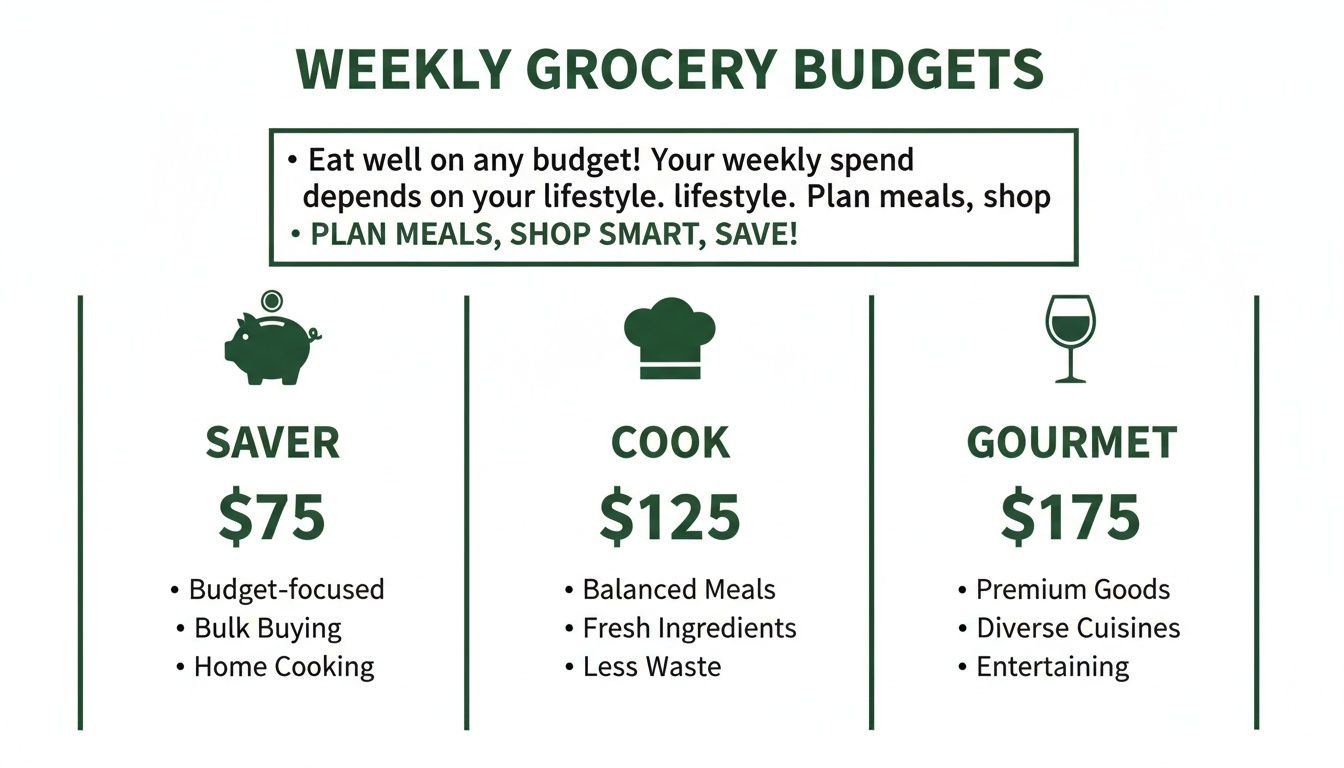
These tiers give you a sense of how Meal Flow AI can adjust to your goals, whether you're trying to hit a lean $75 week or have a bit more breathing room with a $125 plan.
From a Perfect Plan to Zero-Effort Execution
Now, here’s where the real magic happens. Once you've got your meal plan, Meal Flow AI automatically converts it into an organized shopping list. No more forgetting the garlic.
With a single click, that list gets sent over to Instacart, all sorted and ready for checkout. It’s a beautifully simple way to kill impulse buys for good. You're no longer wandering the aisles, tempted by that shiny new flavor of chips. You're on a mission.
The average American spends about 60 hours a year just on meal planning and grocery shopping. AI tools can cut that time by up to 80%, giving you back nearly 50 hours every year. That's more than a full work week back in your pocket.
By automating the list, you completely sidestep the snack aisle's siren song and stick to what you actually need. It's how most of our users end up saving an average of $50-$100 a month on stuff they weren't planning to buy anyway.
This isn't just a gimmick; it's a fundamental shift in how we can manage our kitchens. If you want to dive deeper, you can read more about how AI is revolutionizing meal planning on Forbes.com. It's time to let a little tech do the heavy lifting.
Got Questions About Grocery Budgeting? We’ve Got Answers.
Still have a few things rattling around in your brain? Perfect. Budgeting for one person's groceries comes with its own set of weirdly specific problems. Let’s tackle the most common questions head-on with some real-world advice to help you shop like a pro.
How Do I Deal With Food Prices That Change Every Week?
It’s not just you—it really does feel like the price of avocados changes with the tides. When grocery prices are a rollercoaster, your best friend is flexibility. This is where you learn to stop thinking in terms of rigid meals, like "I must make chicken fajitas."
Instead, start thinking in building blocks: a protein, a veggie, a carb.
That simple mental shift is a game-changer. When you hit the store and see chicken breast is priced like it’s made of gold, but pork loin is on a massive sale, you can just swap it out. No drama, no busted budget. Building your menu around what’s on sale is your secret weapon against unpredictable price swings.
What’s the Best Way to Build a Pantry Without Going Broke?
Staring at empty kitchen cabinets can feel like a direct assault on your bank account. Don't panic. The trick is to build it up slowly, not in one giant, soul-crushing shopping trip. That's a surefire way to blow your entire budget.
The smart move? Carve out a tiny piece of your weekly budget, maybe just $10-$15, and dedicate it to stocking up. Each week, grab one or two things with a long shelf life that you don't need right now.
- Week 1: A big bag of rice and a decent bottle of olive oil.
- Week 2: A multi-pack of spices and some canned tomatoes.
- Week 3: A few boxes of pasta and a couple of cans of beans.
Do this for a month or two, and you’ll suddenly have a fantastic pantry without ever feeling the pain. It's a marathon, not a sprint.
Think of your pantry as your kitchen's emergency fund. When it’s well-stocked, you can always whip up a cheap and tasty meal, even if the fridge is looking a little bare.
Do I Have to Buy Organic to Eat Healthy?
Nope. Not at all. Let's clear this up right now. While organic has its place, a truly healthy diet is way more about what you're eating—fruits, veggies, whole foods—than whether it has a specific sticker on it. You can eat incredibly well on a tight budget with good old-fashioned conventional produce.
If you want to find a happy medium, check out the "Dirty Dozen" and "Clean Fifteen" lists. These handy guides tell you which produce has the highest pesticide residue and which has the least.
This lets you be strategic. You can splurge on organic for the stuff on the "dirty" list (like strawberries or spinach) and save your cash by buying conventional for the "clean" items (like avocados or sweet corn). It’s the perfect compromise for your health and your wallet.
---
Tired of the weekly budgeting grind? Meal Flow AI does the heavy lifting for you. It whips up personalized meal plans that actually fit your budget and sends your shopping list straight to Instacart with one click.
Start your free trial at https://mealflow.ai and see how easy saving money can be!