How Long Does Cooked Chicken Last? Your Ultimate Guide
Wondering how long does cooked chicken last in the fridge or freezer? Get our expert guide on storage times, safety tips, and how to tell if it's bad.
Love This Article?
Get personalized meal plans with recipes like this, automatically matched to your nutrition targets.
You've just pulled off a fantastic chicken dinner, and now you're faced with the leftovers. What's the game plan? How long is that delicious chicken actually good for?
When stored properly in the fridge, your cooked chicken is good for 3 to 4 days. Think of this as your golden rule for keeping meals both tasty and safe.
The 4-Day Rule for Storing Cooked Chicken
Let's be honest, nobody wants to play a guessing game with their food. That’s where the 4-Day Rule comes in to save the day. It’s a simple, no-fuss guideline that takes the anxiety out of leftover chicken.
It’s basically your kitchen’s safety net. Once you pass that four-day mark, the risk of nasty bacteria setting up camp starts to climb, even if the chicken still looks and smells perfectly fine. This isn't just some number pulled out of a hat; it’s a trusted standard that helps you dodge foodborne illnesses and makes sure your meal-prepping efforts don't end up in the bin.
Your Go-To Storage Guide
For anyone juggling a busy schedule or deep into the meal prep lifestyle, that 3-4 day window is the most important timeframe to remember. The USDA is clear on this: cooked chicken kept at 40°F (4°C) or below needs to be eaten or moved to the freezer within this period.
This rule applies across the board, whether you've got a whole roasted bird, some grilled breasts, or shredded chicken for tacos. So, if you cook a batch of chicken on Sunday, your deadline to eat it is Thursday. Simple as that. For a deeper dive into the official recommendations, you can explore detailed food safety guidelines for home kitchens.
Knowing where you're storing your chicken—and for how long—is the key to keeping it safe. Let's make it even easier with a quick reference guide.
Cooked Chicken Storage At a Glance
Here’s a quick-and-dirty cheat sheet for keeping your cooked chicken fresh and safe, no matter where you stash it.
| Storage Location | Recommended Temperature | Safe Storage Time |
| Refrigerator | At or below 40°F (4°C) | 3-4 days |
| Freezer | At or below 0°F (-18°C) | 2-6 months |
| Room Temperature | 41°F - 135°F (5°C - 57°C) | Less than 2 hours |
This little table is your best friend for avoiding any "should I or shouldn't I?" moments when you're staring into the fridge.
Pro Tip: Whatever you do, never leave cooked chicken sitting on the counter for more than two hours. This is the infamous "danger zone," where bacteria throw a party and multiply like crazy. If it's a hot day and the room is over 90°F (32°C), that safety window shrinks to just one hour. Sticking to this is one of the easiest and most effective ways to keep food poisoning out of your house.
Why Your Fridge Temperature Is a Game Changer
Ever had a batch of perfectly good chicken leftovers go funky way too soon? It’s happened to all of us. More often than not, the secret villain is your refrigerator's temperature.
Think of your fridge as a bouncer at an exclusive club, and the troublemakers are bacteria. The right temperature—a chilly 40°F (4°C) or below—keeps those party-crashing germs from multiplying. Let it get any warmer, and you’ve rolled out the red carpet for them.
Welcome to the Danger Zone
There's a notorious temperature range in the food world known as the “danger zone,” spanning from 40°F to 140°F (4°C to 60°C). It’s basically a five-star resort for bacteria like Salmonella and Listeria, where they can double their numbers in just 20 minutes. Yikes.
Keeping your fridge set at or below 40°F (4°C) slams the door on that party. It's the single most important thing you can do to make sure your delicious cooked chicken stays safe to eat for as long as possible.
What a Few Degrees Can Do
It's easy to set your fridge dial and forget it, but even a small temperature shift has a huge impact. For instance, one study found that cooked chicken breast lasted about 23 days in a lab setting at 35°F (2°C). But when the temperature was bumped up to a still-cool 45°F (7°C), its shelf life nose-dived to just 9 days.
This is exactly why the experts stick to a conservative 3-4 day rule for home refrigerators. Your kitchen isn't a sterile lab. The door is constantly opening, warm air rushes in, and it's full of other foods. That 4-day guideline is your real-world safety net.
Your fridge isn't just a cold box; it's a dynamic environment. Every time you open that door, warm air sneaks in, creating temporary hotspots that give bacteria the green light to grow.
Common Fridge Mistakes Sabotaging Your Leftovers
Even if your fridge is set to the perfect temperature, a few bad habits can ruin everything. We've all been guilty of it.
The most common culprit? An overstuffed fridge. When you cram every shelf full, you block the cold air from circulating. This creates warm pockets where your chicken could be unknowingly sitting in the danger zone. Another classic mistake is putting a container of still-hot chicken straight into the cold. This can raise the overall temperature inside, putting all your other food at risk.
Proper storage is all about thinking like the pros. They are experts at mastering temperature control for food safety, and you can be, too. A little attention to airflow and organization goes a long way. If your fridge looks like a disaster zone, check out our guide on https://mealflow.ai/blog/how-to-organize-refrigerator to get things in order for maximum freshness.
How to Properly Store and Freeze Cooked Chicken
Knowing the food safety rules is one thing, but mastering storage is how you actually win the war against spoiled food and wasted money. Once your chicken is cooked, the clock starts ticking. Your number one mission is getting it cooled down and tucked away safely.
This isn't just about keeping it tasty—it's about keeping it safe.
The golden rule you need to burn into your brain is the Two-Hour Rule. You have a two-hour window from the moment your chicken leaves the heat to get it into the fridge. Think of it as hitting the emergency brake on bacterial growth, yanking your food out of that temperature "danger zone" before things get sketchy. Letting it hang out on the counter any longer is just asking for trouble.
Cooling and Storing Chicken in the Fridge
The secret to cooling chicken quickly is giving the heat an easy escape route. Shoving a giant, hot pot of chicken soup directly into the fridge is a bad move; it can actually raise the internal temperature of your whole fridge, putting other foods at risk.
Instead, you need to divide and conquer.
- Break It Down: Split large batches of chicken into smaller, shallow containers. This simple trick dramatically increases the surface area, letting the chicken cool down in a fraction of the time.
- Lock It Up: Once it's cool, transfer the portions into airtight containers or trusty resealable bags. This keeps the chicken from drying out into a sad, leathery state and prevents it from soaking up that weird "fridge smell."
- Date Night: Get in the habit of labeling everything. A little piece of masking tape and a marker with the date saves you from playing "leftover roulette" later in the week.
Proper storage is also your first line of defense against nasty bugs spreading around your kitchen. For a deeper dive, check out these effective ways to prevent cross-contamination.
Freezing Chicken for Long-Term Success
The freezer is your meal-prep superpower. It's like a time machine for your food, locking in flavor and texture for months... if you do it right. The big villain in this story is freezer burn. Those nasty ice crystals are the result of air getting to your food, which sucks out the moisture and leaves it tasting like cardboard.
Your best defense is a strong offense, and that means packaging it like a pro.
- Airtight is Non-Negotiable: This is where you bring out the big guns: heavy-duty freezer bags, vacuum-seal bags, or containers specifically made for the freezer. Your goal is to squeeze out every last bit of air before you seal it. For some great recommendations, have a look at this guide on the best containers for freezing meals.
- Double-Wrap for Victory: Want extra insurance? Wrap individual pieces of chicken (like breasts or thighs) tightly in plastic wrap or aluminum foil before putting them into a freezer bag. This double barrier is an absolute champion at preventing freezer burn.
- Future-You Will Thank You: Freeze your chicken in portions you’ll actually use. It makes thawing a breeze because you can just grab a single serving for lunch or enough for a family dinner without defrosting a giant, frozen brick of chicken.
The Ultimate Meal Prep Tip: Become a labeling fanatic. Seriously. Every single bag or container heading for the freezer needs a clear label with two key pieces of info: what it is ("Shredded Taco Chicken") and the date it was frozen. This tiny habit transforms your freezer from a chaotic ice cave into an organized library of future meals and ensures you’re always using the oldest stuff first.
How to Tell If Cooked Chicken Has Gone Bad
So you think you’ve got a superpower for sniffing out bad food? While the old "sniff test" is a decent starting point, your nose can sometimes be fooled. The real trick to knowing how long cooked chicken actually lasts is learning to spot the subtle—and not-so-subtle—clues that it's past its prime.
Think of yourself as a food safety detective. It’s way less complicated than it sounds. You just need to tune into your three best tools: your eyes, your nose, and your sense of touch. They'll tell you the real story hiding in that container of leftovers.
Trust Your Senses
When chicken decides to turn on you, it sends out some pretty obvious SOS signals. You just need to know the language.
- Look for Color Changes: Freshly cooked chicken should look, well, like chicken—white or light brown. If you pop open that container and see a funky grayish or even greenish tint, that’s your first major red flag.
- Feel for a Slimy Texture: Give it a gentle poke. Good chicken feels moist. Bad chicken feels… gross. If it’s coated in a sticky, slick, or slimy film, that's bacteria throwing a party you definitely don't want to attend.
- Sniff for Off Odors: This is the classic test for a reason. Spoiled chicken has a smell that's hard to miss. If you catch a whiff of anything sour, acidic, or vaguely ammonia-like, its final destination is the trash can. No questions asked.
This handy flowchart breaks down the basic game plan for your cooked chicken. It's a simple set of choices to help you decide whether to eat it now or save it for a rainy day.
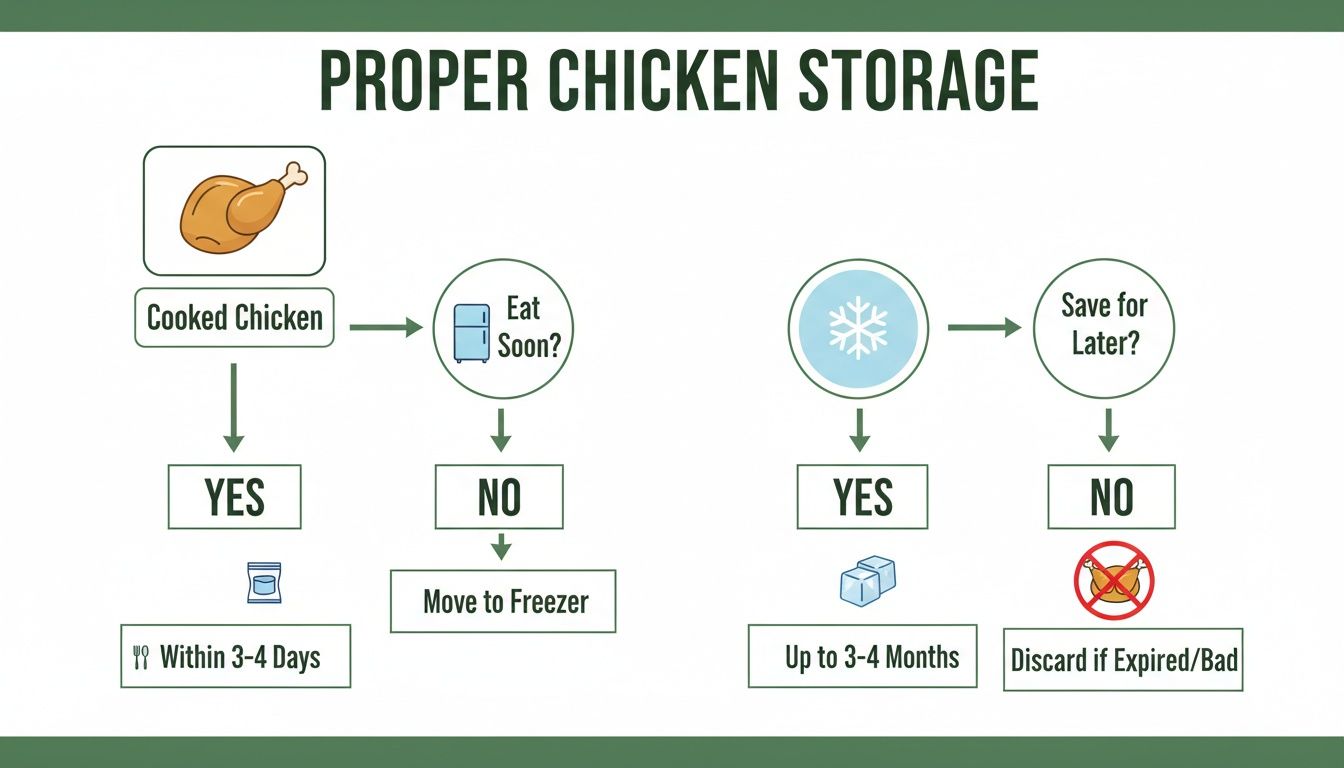
As the guide makes crystal clear, you've got two safe paths: the fridge for a few days or the freezer for the long haul. The kitchen counter is strictly off-limits.
The Most Important Food Safety Rule
Now for the plot twist. The truly nasty bacteria—we're talking Salmonella, Listeria, and their friends—are completely invisible. They don't make the chicken smell bad or look weird, but they can still be multiplying like crazy.
This is why there's one golden rule that trumps all the others. It's the one you should have posted on your fridge.
When in doubt, throw it out.
Seriously. It is never, ever worth the risk. If that chicken has been hanging out in the fridge for more than four days, or if you have even the tiniest suspicion that something’s not right, don't talk yourself into eating it. Tossing a couple of dollars' worth of leftovers is infinitely better than spending the next few days regretting your decision. Your stomach will thank you.
Getting Your Leftover Chicken Ready for Round Two
You did the hard part. You cooked a fantastic meal and tucked the leftovers away like a food-safety champion. Now, how do we make sure that chicken is just as incredible the second time around?
Properly reheating isn't just about getting it hot. It's a delicate dance between food safety and preventing that once-juicy chicken from turning into a sad, rubbery mess. And if you froze it, the first move is a safe thaw.
I know it's tempting, but please, don't just leave that frozen block of chicken on the counter. It might seem harmless, but it's an open invitation for a bacterial party. The outside thaws quickly and enters that dreaded "danger zone" while the inside is still an ice cube, giving nasty microbes hours to multiply.
The Only Three Safe Ways to Thaw Chicken
To keep your food safe and delicious, stick to one of these three tried-and-true thawing methods. Your choice really just depends on how much time you have.
- The Refrigerator (The Slow & Steady): This is the gold standard of thawing. Just move your chicken from the freezer to the fridge. It's hands-off and foolproof, keeping the chicken at a consistent, safe temperature below 40°F (4°C). The only catch? You have to plan ahead, as it can easily take a full day.
- Cold Water Bath (The Quicker Fix): In a bit of a rush? Put the chicken in a completely sealed, leak-proof bag and submerge it in a bowl of cold tap water. The key here is to change the water every 30 minutes. This keeps the water temperature from creeping up and becoming a bacterial playground.
- The Microwave (The Emergency Button): This is your "Oh no, I forgot to thaw the chicken!" lifeline. Use your microwave's defrost setting and be ready to babysit it. You'll need to stop and rotate it frequently to prevent the edges from cooking while the center is still frozen solid. If you use this method, you must reheat and eat the chicken immediately afterward.
Reheating Like a Pro
Once your chicken is thawed, it's time for the final act: bringing it back to its former glory. There's one rule you absolutely cannot break.
Your chicken must reach an internal temperature of 165°F (74°C). No exceptions. This is the magic number that obliterates any bacteria that might have tried to make a comeback.
A food thermometer is non-negotiable here. Seriously. Guessing is just not an option when it comes to food safety. Pop that thermometer into the thickest part of the chicken to know for sure you’ve hit the mark.
To keep it from drying out, try adding a splash of broth or water before covering it to reheat in the oven or on the stovetop. If you're using the microwave, draping a damp paper towel over the top works wonders to trap steam and keep it tender.
For more savvy ways to work with your leftovers, check out our complete guide on how to meal prep chicken.
Still Got Questions About Storing Cooked Chicken?
Alright, so we've covered the main rules, but the kitchen is never that simple, right? Real life is full of "what-ifs" and "can-I-just..." moments. Let's dive into some of the most common questions that pop up when you're standing in front of the fridge, playing a game of chicken with your leftovers.
Think of this as your rapid-fire round to settle those debates once and for all and make you the undisputed food-safety champ of your household.
Can I Eat Cooked Chicken After 5 Days?
We’ve all been there. You’re staring at a container of chicken on day five, giving it a good sniff and thinking, "Eh, seems fine to me..." I get the temptation, I really do. But this is one of those times you have to trust the science, not your senses.
The official, safety-first answer is a hard no.
That 3-to-4-day rule isn't just a friendly suggestion; it's a firm deadline designed to keep you safe from some seriously nasty, invisible bugs. Bacteria like Listeria and Salmonella are the silent party crashers of the food world—they can multiply to dangerous levels long before the chicken starts to smell funky or look slimy.
Think of the 4-day mark as a non-negotiable checkout time. If you know you won't get to the chicken by then, your best bet is to toss it in the freezer on day three. That hits the pause button on any bacterial shenanigans and keeps it fresh for another day.
Does the Cooking Method Affect How Long It Lasts?
This is a great question. Does that fiery, grilled tandoori chicken have a longer shelf life than a simple poached breast? It feels like it should, but the answer is surprisingly straightforward: not really.
The universal 3-to-4-day rule holds true across the board, whether your chicken was roasted, fried, grilled, or boiled. While a super acidic marinade (think lots of vinegar or lemon juice) might slow down bacterial growth a tiny bit, it’s not enough to officially extend that safety window. Don't count on it.
What truly matters are the fundamentals we keep coming back to:
- Cooling it down fast: Getting it out of that temperature "danger zone" within two hours is critical.
- Sealing it up tight: Airtight containers are your best friend for keeping moisture in and contaminants out.
- Keeping it cold: Your fridge needs to be humming along at or below a steady 40°F (4°C).
Nail these three things, and you can rest easy knowing your chicken is safe, no matter how you cooked it.
What's the Best Way to Store Chicken for Meal Prep?
For all you meal-prep warriors out there, mastering chicken storage is the secret to a week of easy, delicious meals. The ultimate strategy isn't about choosing the fridge or the freezer—it's about using both like a pro.
I call it the "split storage" method. After you've cooked that big batch of chicken on Sunday, portion it out immediately. Figure out what you can realistically chow down on in the next 3 to 4 days and pack those servings into airtight containers for the fridge.
Everything else? It's heading straight for the freezer. Package it up in labeled and dated freezer bags or containers, preferably in single-serving portions. This gives you the best of both worlds: grab-and-go convenience for the first half of the week, and perfectly preserved chicken ready to thaw for your meals later on. It's the smartest way to stop wasting food and actually stick to your meal plan.
Can I Put Hot Chicken Straight Into the Fridge?
Ah, the classic kitchen dilemma. You know you need to cool the chicken down fast, but you've probably heard that putting hot food in the fridge is a huge no-no. The truth is a bit more nuanced. You absolutely should not shove a massive, steaming-hot pot of chicken stew or a whole roast chicken directly into the cold.
Why? Because it acts like a space heater, raising the temperature inside your entire fridge. This creates a temporary "danger zone" that puts all your other food—the milk, the cheese, the yogurt—at risk.
The trick is to divide and conquer.
- Break It Down: Get the hot chicken out of the big pot or pan and into several smaller, shallow containers. More surface area means faster cooling.
- Let It Breathe: Leave the containers on the counter for about 30 to 60 minutes, just long enough for the thick clouds of steam to disappear.
- Chill Out: Once it’s no longer steaming like a sauna, you can safely pop the containers into the fridge to finish cooling completely.
This method gets your chicken below that crucial 40°F (4°C) mark well within the two-hour safety window, all without turning your fridge into a warm, bacteria-friendly bath.
---
Ready to make meal planning and grocery shopping ridiculously easy? At Meal Flow AI, we use smart technology to create personalized meal plans you'll love and then send the shopping list directly to Instacart.
Click here to discover how Meal Flow AI can simplify your life!